We deliver end-to-end HR solutions tailored to your business goals—helping you build scalable, compliant, and future-ready HR frameworks.
Employee Onboarding & Offboarding: A Complete Process Guide
Employee onboarding is the structured process of integrating a new hire into a company, from paperwork to full productivity. Employee offboarding is the reverse process, which includes managing an employee's exit through knowledge transfer, asset recovery, and final settlement. Together, they form the entry and exit points of the employee lifecycle, and how well a company handles both says a lot about how it treats people.
Most HR teams run onboarding and offboarding as two disconnected checklists, one owned by recruitment, the other handled reactively once a resignation letter arrives. That gap costs real productivity and real compliance risk. Fast-growing companies, especially in hubs like Jaipur, are now turning to HR onboarding solutions in Jaipur to close that gap instead of patching it manually every time someone joins or leaves.
This guide covers the onboarding and offboarding process of employees step by step, along with the statutory timelines Indian employers need to track.
What Is Employee Onboarding and Offboarding?
Employee onboarding is the journey of welcoming a new hire, verifying documents, setting up systems, and training them until they're contributing independently. Good onboarding stretches across the first 90 days, not just orientation week.
Employee offboarding is the structured, respectful process of managing an employee's departure, from handover to final paycheck.
Here's the part most guides skip: offboarding is onboarding in reverse. During onboarding, company knowledge flows into the employee. During offboarding, that knowledge (project history, client context, credentials) has to flow back out before the person leaves. Treat both as one connected system, not two separate chores, and you protect data security, compliance, and employer brand at once.
Why These Processes Matter for Modern Businesses
- Time-to-productivity. A new hire with structured pre-boarding starts contributing weeks earlier than one figuring things out alone.
- Statutory compliance. Missed PF or ESIC filings, or late wage settlements, invite penalties that are entirely avoidable.
- Retention. A large share of early attrition traces back to a confusing onboarding experience, not the job itself.
- Brand and data protection. Every day a former employee's login stays active is unnecessary security exposure.
The Employee Onboarding Process: Step by Step
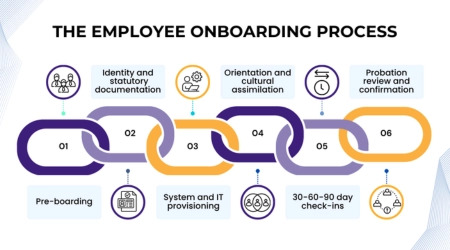
Executing a structured employee onboarding process requires clear milestones that guide a new hire from offer acceptance through their first 90 days.
Pre-boarding.
The work starts before the new hire ever walks through the door. Utilizing digital onboarding solutions in Jaipur allows growing businesses to get documents collected digitally before Day 1, so you don't wait until onboarding morning to introduce them to the team.
Identity and statutory documentation.
EPF Form 11, ESIC enrollment, bank details, all of it needs to be locked in early. Chase this on day one and you will spend week one fixing payroll instead of training anyone.
System and IT provisioning.
Nothing kills first-day energy like a new hire sitting at an empty desk waiting for IT to "raise a ticket." Laptop, email, role-based software access, all of it should already be sitting there when they arrive, not something they're asked to request.
Orientation and cultural assimilation.
Policy walkthroughs matter, but they're not the part anyone remembers. What actually helps a new hire settle in is a mentor or buddy they can ask the dumb questions to, the ones they won't ask their manager.
30-60-90 day check-ins.
Set KPIs early, and actually revisit them. Too many managers set a 90-day plan on day one and then don't look at it again until the annual review, by which point it's basically useless as a coaching tool.
Probation review and confirmation.
Honestly, this is the step most companies quietly skip. Probation ends, nobody formally reviews it, and the employee just stays. A proper review of performance and cultural fit, followed by an actual confirmation letter, closes the loop and tells the employee where they stand instead of leaving it to assumption.
The Employee Offboarding Process: Step by Step
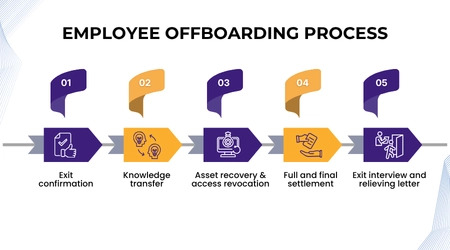
Similarly, an effective employee offboarding process focuses on risk mitigation, data protection, and maintaining employer brand goodwill.
- Exit confirmation. Document the last working day (LWD) and notice terms in writing right away.
- Knowledge transfer. Track handovers and peer sign-offs. This is the most under-invested step in most offboarding processes.
- Asset recovery and access revocation. Collect hardware, retrieve ID cards, and terminate SSO accounts. Don't assume one revoked login cascades to every connected tool; many SaaS platforms hold independent sessions.
- Full and final settlement. Clear wage dues, leave encashment, and statutory payouts within the legal timeline (details below).
- Exit interview and relieving letter. Collect honest feedback, issue the service certificate, and close the records.
Onboarding vs. Offboarding: Key Differences at a Glance
|
Comparison Dimension |
Employee Onboarding Process |
Employee Offboarding Process |
|
Primary direction |
Incoming: integration and growth |
Outgoing: transition and knowledge preservation |
|
Typical timeline |
Pre-boarding through probation confirmation |
Notice period through statutory settlement |
|
Primary risk |
Delayed productivity, early attrition |
Data leaks, asset loss, non-compliance |
|
Key output |
A confirmed, capable employee |
A compliant exit and a goodwill ambassador |
India-Specific Compliance Essentials
This is where otherwise solid HR processes fall apart, mostly because the rules changed recently.
Wage settlement timeline. Under Section 17(2) of the Code on Wages, 2019, an employer must pay all wages due within two working days of resignation, dismissal, retrenchment, or closure. This provision is now treated as binding, so full and final settlement processes built around a 30-45 day cycle need to shrink to a two-day window for wages specifically.
Gratuity payouts. The Payment of Gratuity Act, 1972 sets a separate 30-day window for gratuity, counted from the date it becomes payable, for employees with five years of continuous service. Don't conflate this with the two-day wage rule. They run on two different statutory clocks.
EPFO and ESIC updates. UAN linking, Form 11 filing for new joiners, and marking exit dates on the EPFO portal need to happen on time so future PF transfers aren't delayed.
Shops and Establishments Act. Record retention rules vary by state, so a company based in Rajasthan should check its state-specific schedule rather than assume a national default.
Combined Onboarding & Offboarding Checklist
|
Phase |
Onboarding Milestone |
Offboarding Milestone |
Owner |
|
Pre-stage |
Digital KYC, background check |
Resignation approval, LWD lock-in |
HR Manager |
|
Day 1 / Last day |
Welcome kit, IT asset issue |
IT access deactivation, asset handover |
IT & Operations |
|
Post-stage |
Probation review, confirmation letter |
Wage clearance (within 2 working days), relieving letter |
HR & Finance |
How to Measure Onboarding and Offboarding Effectiveness
Onboarding: time-to-productivity (weeks to full KPI output), 90-day attrition rate, new-hire satisfaction score gathered right after orientation.
Offboarding: turnaround time for full and final settlement against the statutory two-day window, asset recovery rate, and exit interview sentiment, which flags whether strong performers are leaving for reasons the company can actually fix.
Why Onboarding and Offboarding Are Culture Moments
It's easy to treat offboarding as a box-ticking exercise: collect the badge, kill the login, process the payroll. But how a company handles an exit shapes its reputation on Glassdoor and AmbitionBox far more than most HR teams realize.
Employees who leave on good terms often become boomerang hires later, returning with new skills and no ramp-up on culture. They also tend to refer strong candidates years after leaving. None of that happens by accident. It happens because the exit felt respectful instead of transactional.
How Technology and Digital HR Solutions Simplify Both Processes
Manual paperwork is where onboarding and offboarding usually break down, mostly because HR, IT, and Finance end up working off different versions of the same checklist.
Automated document collection and e-signatures remove the back-and-forth. Centralized employee records let IT, Finance, and HR run clearances in parallel instead of waiting on each other, which matters when you're trying to hit a two-day wage settlement deadline.
This is exactly the gap Qbizhr solutions are built to close. For companies scaling across Rajasthan and beyond, a connected platform means new hires get provisioned correctly on day one, and departing employees get settled on time, without HR chasing five people across three departments for one sign-off.
Best Practices and Common Mistakes to Avoid
- Delaying paperwork to day one. Pre-boarding exists so day one isn't spent filling forms.
- Treating probation as passive waiting. A structured confirmation review matters more than most companies give it credit for.
- Conflating wage settlement with gratuity. They run on different statutory clocks; mixing them up in policy language creates compliance risk.
- Delaying third-party access revocation. SSO revocation doesn't always cascade. Every connected app needs individual checking.
Conclusion
Onboarding, probation confirmation, and offboarding aren't three separate HR tasks. They're one continuous lifecycle that shapes how productive an employee becomes, how secure your data stays, and how your company is remembered by the people who worked there. Getting the statutory timelines right protects you legally. Getting the human side right protects your reputation.
If your team is still running these processes on spreadsheets and email threads, Qbizhr's cloud-based onboarding and offboarding platform can help you manage the entire employee lifecycle without the manual chasing.
Frequently Asked Questions
- What does Section 17(2) of the Code on Wages mandate?
Ans. Employers must pay all wages due within two working days of resignation, dismissal, retrenchment, or closure. It applies specifically to wages, not to every component of a full and final settlement, like gratuity.
- What's the difference between a probation review and a performance appraisal?
Ans. A probation review is a one-time evaluation at the end of a defined period, deciding whether an employee is confirmed into a permanent role. A performance appraisal is recurring, usually annual, for already-confirmed employees.
- How do you measure onboarding success?
Ans. Track time-to-productivity, 90-day attrition, and new-hire satisfaction. If new hires ramp up slowly or leave within a few months, the process usually needs a redesign, not more paperwork.
- How can growing companies in Jaipur streamline statutory HR compliance?
Ans. Digital HR platforms built for Indian compliance automate PF, ESIC, and settlement timelines, cutting manual tracking errors. HR onboarding solutions in Jaipur built around local and national compliance help companies avoid penalties tied to missed statutory deadlines.